
Auto Ignition System Detector – Spark Voltage & Coil Tester
Free Tracked Shipping
30-Day Return Guarantee
24/7 Customer Support
Guaranteed Safe Checkout
DESCRIPTION
Find Ignition Problems Faster—Cylinder by Cylinder
Engine running rough, misfiring, or losing power?
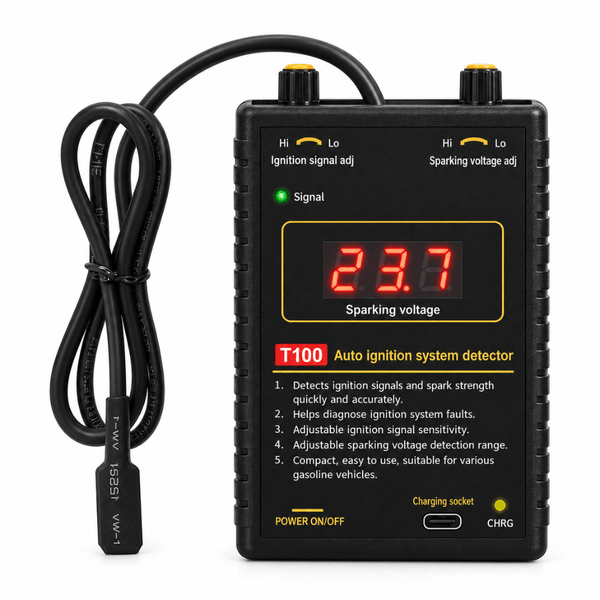
This handheld ignition detector lets you check the ignition signal and compare spark-voltage readings across cylinders—helping you quickly identify the cylinder that behaves differently.
No need to directly contact high-voltage ignition components.
Check. Compare. Find the abnormal cylinder.
Why Choose This Ignition System Detector?
-
Compare cylinders quickly to locate abnormal ignition behavior
-
Detect ignition signals through the inductive probe
-
View spark-voltage reference readings directly on the digital display
-
Non-contact testing near the ignition coil
-
Designed for four-stroke COP / independent ignition systems
-
Rechargeable 400mAh battery with USB-C charging
Spot the Cylinder That Doesn't Match
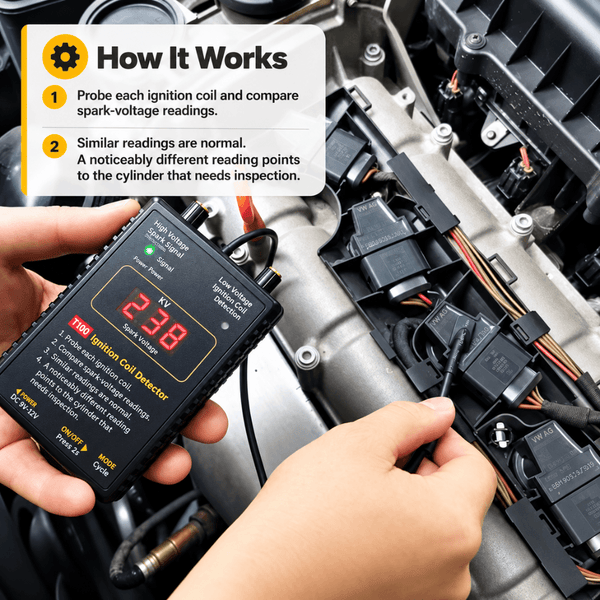
On a properly operating engine, cylinders should normally produce similar spark-voltage reference readings.
Test each ignition coil one by one and compare the displayed values.
If one cylinder is significantly different from the others, you have a clear starting point for further diagnosis.
Diagnose Ignition Problems With Less Guesswork
A rough-running engine can have several possible causes.
By comparing ignition behavior across cylinders, the detector can help point you toward possible issues involving:
- Ignition coils
- Spark plugs
- Ignition circuit problems
- Incorrect spark plug gaps
- Cylinder-related ignition abnormalities
It helps you narrow down the problem before replacing parts blindly.
Detect Both Ignition Signal & Spark Voltage
The detector provides two useful checks:
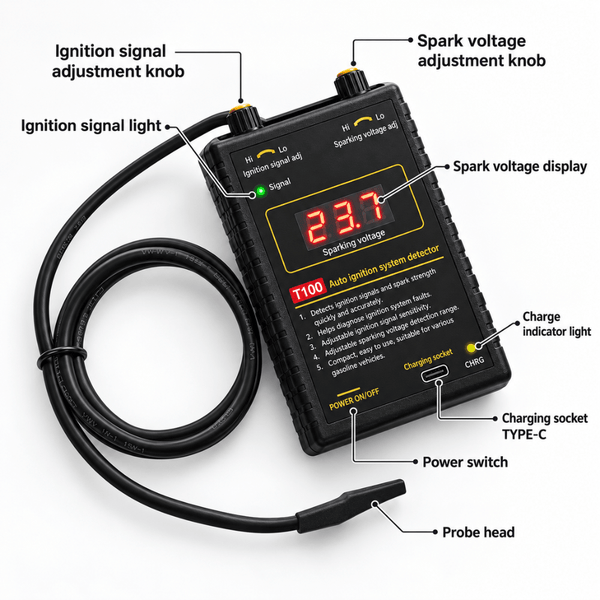
Ignition signal detection
The indicator flashes in response to the detected ignition signal.
Spark-voltage comparison
The digital screen displays a spark-voltage reference value that can be compared between cylinders.
This gives you more information than simply checking whether a coil is firing.
Non-Contact Inductive Testing
Place the probe near the top of the ignition coil and adjust the sensitivity.
There is no need to connect the probe directly to the high-voltage ignition terminal.
Important: The inductive probe must not directly touch high-voltage ignition components.
Built for Comparative Diagnosis
The displayed spark-voltage value should be treated as a diagnostic reference for comparing cylinders, not as a laboratory-calibrated absolute voltage measurement.
That is also its main advantage: you're looking for the cylinder that behaves differently.
For example:
Significantly lower than other cylinders may indicate:
- Ignition coil insulation leakage or internal fault
- Spark plug insulation leakage
- Small spark plug gap
- Carbon/oil contamination
- Low cylinder pressure
- Ignition timing problems
- Coil/spark plug mismatch
Significantly higher than other cylinders may indicate:
- Excessive spark plug electrode gap
- Poor coil-to-spark-plug contact
- Coil/spark plug mismatch
These readings help guide diagnosis; additional testing may still be required to confirm the exact cause.
Perfect For
- Automotive technicians
- Repair shops
- Experienced DIY mechanics
- Engine misfire troubleshooting
- Ignition coil comparison
- Spark plug troubleshooting
- Rough-running engine diagnosis
- Preventive ignition-system checks
- Four-stroke COP ignition systems
How to Use
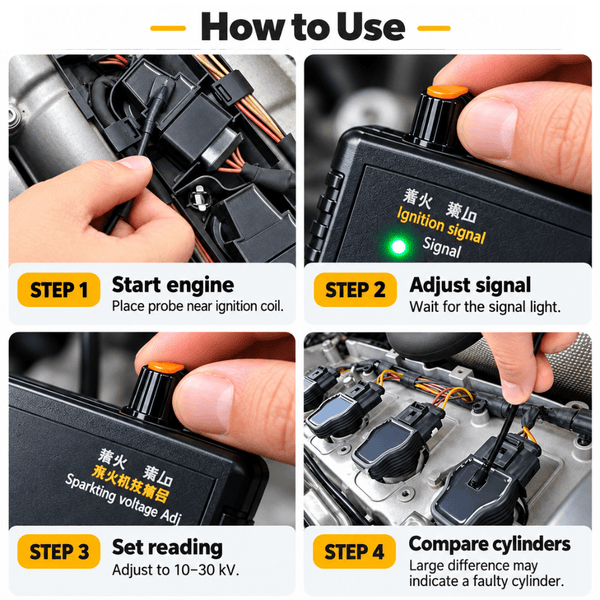
1. Start the Engine
Run the engine normally and locate the ignition coils.
2. Position the Probe
Place the probe head near the top of the ignition coil.
Do not allow the inductive probe to directly touch high-voltage ignition parts.
3. Adjust Signal Sensitivity
Turn the ignition-signal adjustment until the indicator flashes consistently with the ignition activity.
Adjust the probe distance to reduce interference from neighboring ignition coils.
4. Adjust the Spark Reading
Use the spark-voltage adjustment control until a stable reference reading is displayed.
The supplier recommends adjusting the displayed value into approximately the 10–30kV range during testing.
5. Compare Every Cylinder
Repeat the same procedure on each cylinder.
Under normal conditions, readings from cylinders on the same engine should generally be similar.
A significantly different cylinder may require further inspection.
Specifications
| Specification | Details |
|---|---|
| Product Type | Automotive Ignition System Detector |
| Main Functions | Ignition signal detection + spark-voltage comparison |
| Detection Method | Inductive / non-contact probe |
| Spark Voltage Display Range | 0–50kV |
| Recommended Test Display Range | Approx. 10–30kV |
| Ignition Compatibility | Four-stroke independent / COP ignition systems |
| Vehicle System Compatibility | 12V & 24V ignition systems |
| Display | Digital numerical display |
| Battery | Built-in rechargeable lithium battery |
| Battery Capacity | 400mAh |
| Charging Voltage | 5V |
| Charging Port | USB Type-C |
| Controls | Ignition signal adjustment + spark-voltage adjustment |
| Charging Indicator | On while charging; turns off when fully charged |
What's Included
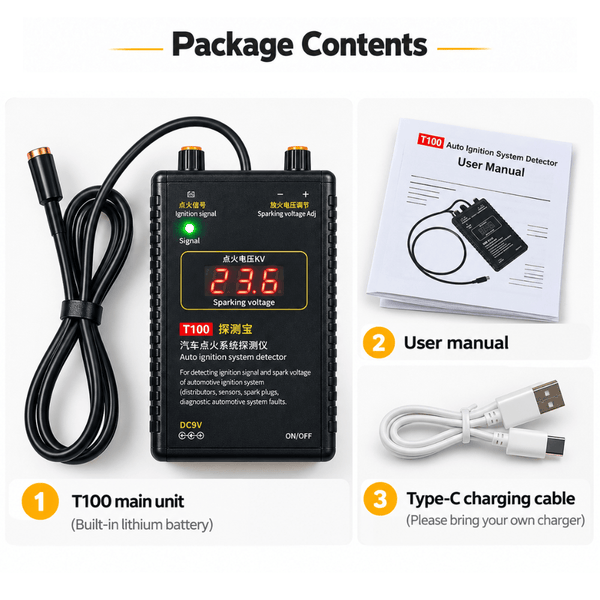
- 1 × Auto ignition system detector
- 1 × Integrated inductive probe
- 1 × USB Type-C charging cable
- 1 × User manual
USB charger/power adapter is not included.
Find the Problem Cylinder Before Replacing Parts
When one cylinder isn't firing like the others, guessing can waste both time and money.
Compare the ignition signal and spark-voltage reference readings across cylinders and quickly narrow your diagnosis to the area that needs attention.
